Flour, Fat, and Formulas: How Home Bakers Are Turning Their Kitchens Into Biscuit Labs
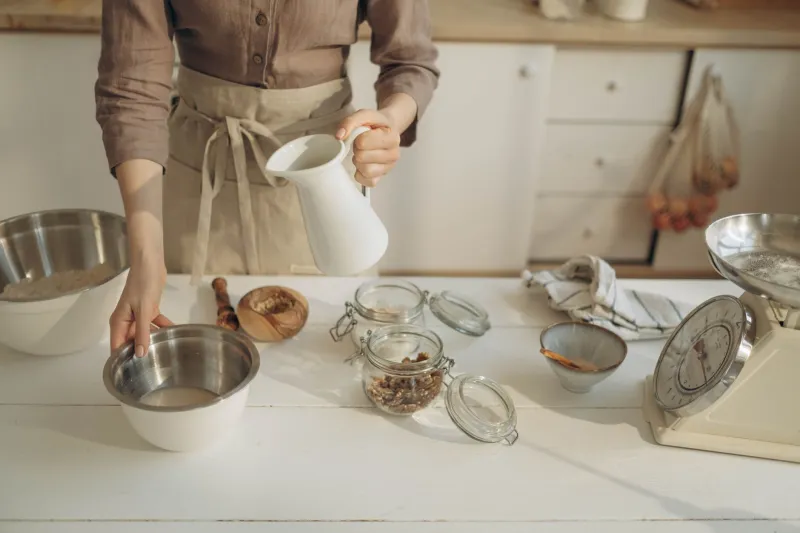
There's a particular kind of frustration that every home baker knows. You follow the recipe to the letter. Same ingredients, same oven, same hands working the dough — and somehow, Tuesday's biscuits are pillowy and golden while Sunday's batch came out dense, pale, and a little sad. No explanation. No apology from the recipe. Just mystery.
For a growing number of home bakers across the country, that mystery has become a personal challenge — one they're solving with tools you'd expect to find in a high school chemistry class, not a cozy farmhouse kitchen. We're talking pH strips, digital gram scales, humidity gauges, and hand-written logs that would make a grad student nod in approval.
Welcome to the age of the biscuit scientist.
When "A Pinch" Stops Being Good Enough
Ask Denise Hartley of Columbus, Ohio, what changed her baking life and she'll point to a single failed batch of drop biscuits she made for her daughter's birthday brunch. "They were gummy inside and weirdly flat," she says. "I'd made that recipe a dozen times. I was so embarrassed."
Instead of shrugging it off, Denise started writing things down. The temperature outside. The age of her baking powder. The brand of buttermilk she'd grabbed in a hurry. Within a few months, her kitchen notebook had turned into a detailed log — almost forty pages of variables, outcomes, and observations.
"I realized I had no idea what was actually happening inside my dough," she says. "Once I started treating it like an experiment instead of just a recipe, everything clicked."
Denise isn't alone. Online baking communities, especially forums on Reddit's r/Breadit and various Facebook baking groups, are full of home bakers who've gone deep into the science of their craft. And biscuits — simple, classic, deeply American biscuits — have become one of the most popular subjects for this kind of methodical obsession.
The Chemistry Your Recipe Never Told You About
Here's the thing: traditional biscuit recipes weren't written to explain themselves. They were passed down through demonstration, through feel, through the kind of muscle memory that only decades of practice can build. When your grandmother told you to use "cold butter," she didn't explain why — she just knew.
But science fills in the gaps beautifully.
Biscuits rely on a leavening reaction between an acid and a base. In most recipes, that's buttermilk (acidic) and baking soda (alkaline), often with baking powder adding a secondary lift. The ratio of acid to base determines how aggressively the dough rises — and this is where pH testing enters the picture.
Some home bakers are now literally testing the pH of their buttermilk before using it. Store-bought buttermilk can vary in acidity depending on brand, age, and even batch. A slightly less acidic buttermilk means your baking soda doesn't react as vigorously, which means less rise, which means denser biscuits. Testing pH — those little strips cost about five dollars at any pharmacy — gives bakers a real data point instead of a guess.
"I tested four different brands of buttermilk one afternoon," says Marcus Webb, a software engineer in Austin who bakes biscuits every Saturday morning. "The pH ranged from about 4.5 to 5.2. That's a meaningful difference when you're trying to hit a consistent rise."
Scales, Humidity, and the War on Inconsistency
The kitchen scale is arguably the most important tool in the biscuit scientist's arsenal — and also the simplest to adopt. Flour is notoriously inconsistent when measured by volume. A cup of all-purpose flour can weigh anywhere from 120 to 160 grams depending on how you scoop it, whether it's been sitting in a humid pantry, or whether it was shaken during shipping. That's a potential 25% variation in your most critical ingredient.
Bakers who've switched to weighing their flour report almost immediate improvements in consistency. "It was like I'd been playing the same song slightly out of tune for years and finally got it right," says Priya Anand, a home baker in Atlanta who documents her biscuit experiments on Instagram.
But Priya didn't stop at the scale. She started tracking ambient humidity in her kitchen after noticing her biscuits behaved differently in Georgia's brutal summer months. A cheap digital hygrometer — the kind used for cigar humidors — revealed that her kitchen regularly hit 70% relative humidity in July, causing her flour to absorb moisture from the air before it even hit the bowl. Her fix? Storing flour in airtight containers and adjusting her liquid ratios by a few grams on humid days.
"It sounds obsessive," she laughs. "But it works."
The Notebook Is the Secret Weapon
What separates the biscuit scientists from regular bakers isn't just the gadgets — it's the documentation. Every serious practitioner in this community keeps records. Date, time, humidity, flour weight, butter temperature, oven calibration, bake time, and outcome. Some bakers even photograph their cross-sections to track interior crumb structure over time.
This kind of logging does something powerful: it separates correlation from coincidence. When you've made the same recipe thirty times with detailed notes, you start to see real patterns. You notice that your biscuits rise better when butter is exactly 45°F rather than just "cold from the fridge." You discover that your oven runs 15 degrees hot on the right side. You find out that your go-to brand of self-rising flour has less leavening than the recipe assumes.
None of this information is hidden — it's just never been in the recipe.
What the Science Actually Teaches You
Here's what biscuit scientists consistently report discovering through their experiments:
Fat temperature matters more than you think. Butter should be cold enough to create steam pockets during baking (that's how you get flaky layers) but not so cold it can't incorporate into the flour. Most experimenters land around 40–50°F as the sweet spot.
Baking powder goes stale faster than you'd expect. Many home bakers discover their leavening has lost significant potency — a quick test (drop a teaspoon in hot water; it should bubble vigorously) can save a whole batch.
Rest time affects gluten development. A short 10-minute rest after mixing lets gluten relax, making the dough easier to handle and reducing toughness. Many traditional recipes skip this entirely.
Oven thermometers are non-negotiable. Almost every baker who invests in one discovers their oven isn't running at the temperature it claims. Even a 25°F discrepancy dramatically changes crust color and interior texture.
You Don't Have to Go Full Lab Mode
If pulling out pH strips feels like a step too far, that's completely fair. The good news is that even adopting one or two of these practices can meaningfully improve your results. Start with a kitchen scale. Write down what you did and how it turned out. Invest in an oven thermometer. These are low-effort, high-reward moves that don't require a science background.
The biscuit scientists would be the first to tell you this isn't about making baking feel like homework. It's about understanding what's happening in your dough so that when something goes wrong, you know why — and more importantly, you know how to fix it.
Because at the end of the day, the goal is still the same as it's always been: warm biscuits, a little butter, and the quiet satisfaction of something made well with your own hands. Science just helps you get there a little more reliably.
And honestly? Grandma would probably approve of that.